What is a Viking sword?
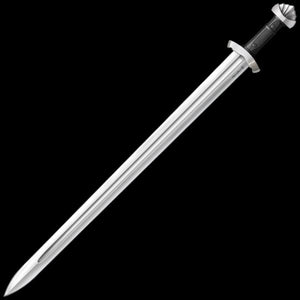
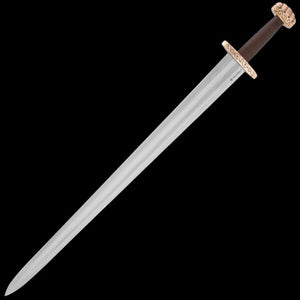
A double-edged straight sword of the Viking Age, roughly 793 to 1066, with a blade of 70 to 90cm, a wide fuller to save weight, a short straight or slightly curved guard, and a distinctive pommel: a plain brazil-nut, a tea-cosy, or the multi-lobed pommel (three, five or seven lobes) that gives the "five-lobe" sword its name. Total weight was usually 1 to 1.5kg. It was a cutting weapon used with a round shield, and its balance sits further forward than a later medieval sword.
Blade construction varied with the owner's wealth. Ordinary swords were plain iron and steel. Pattern-welded blades were built from twisted rods forge-welded together, which produced the rippling surface pattern that modern Damascus steel echoes. The Ulfberht blades, made from unusually pure crucible steel, are the top of the range and were forged in the Rhineland rather than Scandinavia.
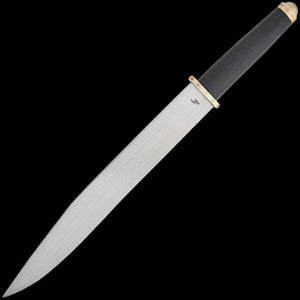
Not every Norse blade was a sword. The seax, a single-edged knife that ranged from a belt knife to a short sword, was the everyday weapon of the whole Germanic world, and the long seax (langseax) was carried as a sword substitute by warriors who could not afford one. Both kinds are on this page.
Hand-forged Viking swords
Cold Steel Viking Sword. The classic pattern: broad double-edged carbon steel blade, wide fuller, lobed pommel. Cold Steel's historical swords are forged to be handled, and this is the one to start with.
Cold Steel Single Edge Viking Sword. Single-edged swords were common in Norway in the early Viking Age, a development of the long seax. Rarer in replica than the double-edged pattern, and a different look on the wall.
Cold Steel Damascus Viking Sword. The same Norse profile with a layered Damascus-pattern blade, the modern equivalent of the pattern-welding the best Viking blades were famous for. The showpiece of the collection.
Hanwei Practical Viking Sword. Hanwei's re-enactment-grade sword: purpose-built for the demands of historical re-enactment, with a tougher blade and plainer fittings than a display piece. The choice for anyone who is going to stand in a shield wall.
Hanwei Tinker 9th Century Viking Sword. Designed by the American smith Michael "Tinker" Pearce and made by Hanwei: a 9th-century pattern with a properly balanced, sharp blade. Sells out fast when it lands; use the notify button.
Honshu Viking Sword and Honshu Historic Forge Viking Sword. Two Honshu swords with ornate pommels and hilts. The standard Viking Sword has a 31-inch 1060 carbon steel blade with a rubber grip and wooden scabbard; the Historic Forge version is the more faithful piece, in 1080 carbon steel with a leather-wrapped handle.
Honshu Historic Forge Balinderry Sword. Based on the sword found at Balinderry in County Westmeath, Ireland, a 9th-century Ulfberht-type blade that is one of the finest surviving Viking swords. A 29.5-inch 1065 carbon steel blade with leather and wood fittings. The most historically specific sword in the collection.
Kingston Arms Tourney Viking Sword. A blunt, rounded-edge steel sword with a through-tang and peened stainless pommel, made for stage combat and re-enactment where a sharp is not allowed.
Seaxes
Cold Steel Chieftain's Seax. A large, broad seax of the kind carried as a status symbol: larger and more ornate than a working knife.
Cold Steel Damascus Long Seax. The langseax, a single-edged short sword in Damascus steel. Big enough to stand in for a sword, as it did for many Norse warriors.
Legacy Arms Witham Viking Seax. Based on the seax found in the River Witham in Lincolnshire, in 5160 carbon steel with a 12-inch blade and leather sheath.
Hanwei Scramasax. The everyday seax, with a stag-horn handle.
Vikings and The Last Kingdom swords
Vikings - Deluxe Sword of Kings and Ragnar's Sword. Two versions of the sword Ragnar Lothbrok carries through the History Channel's Vikings: the Sword of Kings, with its jewelled hilt and rune-etched blade, and the plainer chieftain's sword, both full metal with wall plaques. Lagertha's Sword completes the set. See the full Vikings collection for the shields and axes.
The Last Kingdom - Uhtred's Serpent-Breath. Uhtred of Bebbanburg's sword from The Last Kingdom, blunt and with a display plaque. The rest of the range is in our Last Kingdom collection.
Training and cosplay
Honshu Viking Training Sword. Polypropylene, 31.5-inch blade, indestructible. For drills and demonstrations.
Viking 5 Lobe Sword (Cosplay Safe Wood), plain or painted, for conventions and LARP. See the full cosplay weapons range.
About The Sword Stall
UK-based, UK-stocked. Everything here is in our warehouse in Bacup, Lancashire: no dropshipping, no customs, no import delays. Free delivery on orders over £200. The Cold Steel, Hanwei, Honshu and Legacy Arms swords and seaxes are traditionally forged pieces supplied with a sharpened edge, sold to over-18s only and intended for collection and display, not use. The TV replicas are blunt display pieces, and the tourney and training swords are blunt. New customers provide age verification once before their first order is dispatched.