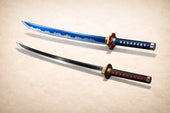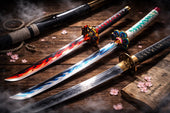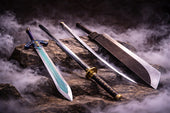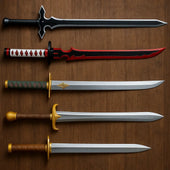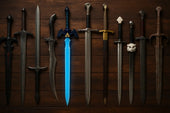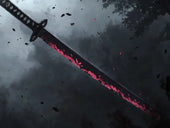

Of all the blades in Demon Slayer: Kimetsu no Yaiba, none is more unsettling, or more visually arresting, than Kokushibo's sword. Where most Nichirin Blades start and end as recognisable katana variants, Kokushibo's weapon is something else entirely: a crescent-edged, multi-bladed monstrosity with eyes embedded in the steel, pulsing with the same demonic power as its wielder. It is equal parts Japanese sword history and pure nightmare fuel.
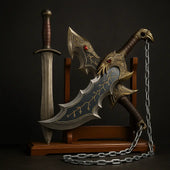
Kokushibo’s sword in Demon Slayer began as a traditional Nichirin katana but evolved into a demonic weapon fused with his own flesh. With multiple crescent blades, embedded eyes and a crimson edge, it deliberately breaks historical katana design, symbolising his fall from disciplined samurai to monstrous Upper Moon One.
But here's what makes Kokushibo genuinely fascinating from a sword design perspective: he did not start with that blade. He started with a katana. Understanding how and why his sword broke from traditional design tells you a great deal about both Demon Slayer's world-building and the real history of Japanese swordsmanship it draws from.
Who Is Kokushibo? The Swordsman Behind the Demon
Before dissecting the blade, it's worth understanding the man who carried it, because Kokushibo's history is inseparable from his weapon.
Kokushibo was born Michikatsu Tsugikuni, a samurai of extraordinary talent during Japan's Sengoku period (roughly 1467–1615). He was the twin brother of Yoriichi Tsugikuni, the greatest swordsman in the series' history and the original practitioner of Sun Breathing. Michikatsu, for all his gifts, could never surpass his brother. Consumed by that inadequacy and terrified of dying before he could reach his potential, he accepted the offer to become a demon under Muzan Kibutsuji, eventually rising to become Upper Moon One, the most powerful demon beneath Muzan himself.
He lived for approximately four hundred years as a demon, and in that time his sword evolved with him. What began as a conventional Nichirin Blade gradually transformed into something that no human swordsmith ever designed and no historical tradition ever produced.
That transformation is the key to understanding why Kokushibo's sword breaks every rule of traditional katana design.
What a Traditional Katana Actually Looks Like
To appreciate how radically Kokushibo's blade departs from convention, you need a clear picture of what a traditional katana is.
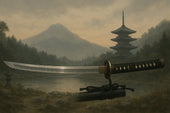
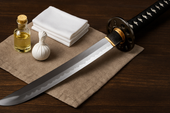
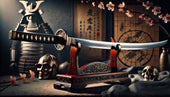
A katana is a single-edged, curved sword typically measuring between 60 and 80 cm in blade length. The design philosophy behind it is built on efficiency and elegance: one cutting edge, a clean curvature (sori) that aids draw-cutting technique, a long two-handed grip (tsuka) for leverage and control, a hand guard (tsuba) that is present but deliberately understated, and a blade geometry optimised for the draw-cut (iaijutsu) and the follow-through stroke.
Historically, the katana reached its definitive form during the Muromachi period (1336–1573), where it replaced the older tachi as the sword of choice for samurai fighting on foot. The genius of the katana is its discipline: nothing is superfluous. Every curve, every proportion, every element of the heat treatment process serves a specific mechanical purpose.
Real katanas are forged from tamahagane steel through days of smelting iron sand in a clay furnace (tatara), then folded, hammered, and differentially hardened to produce a hard cutting edge (hagane) layered over a tough, shock-absorbing spine (shingane). The result is a weapon of exceptional refinement. If you want to own a blade that reflects this tradition, The Sword Stall's Katana & Samurai Sword collection ranges from authentic display pieces through to genuinely hand-forged blades made to samurai standards.
Kokushibo's Sword: A Design That Should Not Exist
Against that backdrop of disciplined, purposeful design, Kokushibo's sword is a deliberate violation of almost every principle the katana represents.
Multiple Blades Growing from a Single Sword
The most immediately striking feature is the blade's structure. Kokushibo's Nichirin sword does not have a single cutting edge. It has multiple crescent-shaped subsidiary blades growing organically from the main blade, positioned asymmetrically along its length. These extra blades emerge because Kokushibo's own body, his flesh, has fused with the weapon. The sword is no longer just a tool he wields; it is an extension of his demonic physiology.
From a historical standpoint, there is no direct Japanese equivalent. The closest real-world precedents are found in ceremonial or ritual weapons rather than battlefield arms. The naginata (a curved pole weapon) and certain decorative yari (spear) variants featured additional protrusions or decorative elements, but these were structural, not organic. A sword that literally grows secondary blades from its body exists nowhere in the historical record, because steel does not behave like flesh.
The design communicates something important narratively: Kokushibo has abandoned the discipline of the human swordsman in favour of something wilder and more monstrous. His weapon reflects that abandonment.
The Eyes in the Blade
Perhaps the most viscerally disturbing feature of Kokushibo's sword is the eyes embedded within it. Multiple eyes, functional and blinking, are distributed across the blade's surface, a manifestation of his demonic Flesh Manipulation ability.
No historical blade carries eyes. The closest cultural parallel is perhaps the idea of the tamashii (soul) of the swordsmith being present in the blade, a spiritual concept in Japanese sword-making culture, where a finished blade was thought to carry the spirit and intent of its maker. But that is metaphor. Kokushibo's eyes are literal, and they serve a practical function: they give the blade a kind of spatial awareness, making his Moon Breathing techniques even more difficult to anticipate and counter.
Blade Length and Proportions
Kokushibo's sword is significantly longer than a standard katana, sitting closer to the proportions of a tachi or even approaching nodachi territory. The tachi was the predecessor to the katana, worn edge-down by mounted samurai, and typically measured between 70 and 80 cm or more. The nodachi or odachi pushed further still, sometimes exceeding 90 cm, and was used by warriors of exceptional physical strength.
Given Kokushibo's four centuries of existence and his position as the most powerful demon beneath Muzan, the extended proportions make narrative sense: he wields a blade that a normal human could not control, because he is no longer constrained by human physicality.
The Crimson Red Colour
Kokushibo's blade is crimson red. In Demon Slayer's lore, Nichirin Blades used by demons turn red because the demon's own blood and cellular structure permanently infuses the steel. For human Demon Slayer Corps members, turning a blade red requires tremendous physical effort, essentially squeezing blood from the body into the sword in a moment of desperate need. For Kokushibo, red is the default, a constant reminder that his blade is no longer the weapon of a swordsman but the weapon of a predator.
Red-bladed katanas do not exist in historical Japanese sword-making. The colour variation in real blades comes from the hamon, the temper line formed during differential hardening, which produces a whitish or misty pattern along the cutting edge. Some blades develop a dark, almost black patina over centuries of oxidisation. But vivid crimson is pure fiction, and all the more striking for it. That said, it is exactly what makes the Demon Slayer sword replicas in The Sword Stall's collection so visually commanding on a wall.
What Kokushibo's Sword Gets Right: The Historical Roots
For all its fantastical elements, Kokushibo's sword is not entirely divorced from historical Japanese weapon design. Several details reveal careful research on Gotouge's part.
Moon Motif and Japanese Symbolism: The crescent shapes that dominate Kokushibo's blade aesthetic are deeply rooted in Japanese warrior culture. The crescent moon (mikazuki) was a common motif in samurai heraldry (mon) and was associated with clarity of mind, impermanence, and the Buddhist concept of cycles. One of Japan's most famous swords, the Mikazuki Munechika (one of the five greatest swords in Japanese history, forged in the 10th or 11th century), takes its name directly from the crescent moon shape of its hamon. Kokushibo's Moon Breathing and crescent-dominated blade design tap into this tradition with clear intent.
The Sengoku Period Setting: Kokushibo's human life falls during the Sengoku period, when Japan was locked in a century and a half of near-constant civil war. This was the era of the odachi-wielding foot soldier, of rapidly evolving sword schools, and of battlefield swordsmanship at its most pragmatic and brutal. A samurai of that period trained in the art of killing in a way that the later, more ceremonial Edo period never quite matched. Kokushibo carries that violence in his technique even four centuries later.
Moon Breathing as a Real Sword School Concept: The Breathing Styles in Demon Slayer are a fictional rendering of the real Japanese concept of kenjutsu ryu (sword school). Historical schools like Kage-ryu, Tenshin Shoden Katori Shinto-ryu, and Itto-ryu each codified specific techniques, stances, and cutting philosophies into formalised curricula passed from master to student. Kokushibo developed Moon Breathing himself as a derivative of his brother Yoriichi's Sun Breathing, which mirrors the historical reality of schools branching and evolving through lineage. It is this depth of lore that sets Demon Slayer apart from other anime series, and it is reflected across the anime sword replicas The Sword Stall stocks from One Piece, Bleach, Final Fantasy, and beyond.
Kokushibo's Sword vs Traditional Katana: The Breakdown
|
Feature |
Traditional Katana |
Kokushibo's Sword |
|
Single cutting edge |
Yes |
No (multiple crescent blades) |
|
Standard curvature (sori) |
Yes |
Exaggerated/irregular |
|
Tamahagane / high-carbon steel |
Yes |
Fused with demonic flesh |
|
Blade length |
60–80 cm |
Extended (tachi/nodachi range) |
|
Eyes in blade |
No |
Yes (demonic feature) |
|
Colour |
Silver/grey with hamon |
Crimson red |
|
Moon motif |
Symbolic/hamon only |
Structural and aesthetic |
|
Historical precedent |
Complete |
Partial (motif only) |
Why Kokushibo's Sword Design Works So Well
From a pure design perspective, Kokushibo's sword is one of the most successful villain weapons in modern anime, and the reason is straightforward: it tells his story without a single word of dialogue.
A sword that started as a katana and was corrupted into something organic, asymmetrical, and multi-eyed reflects a swordsman who started with the discipline of kenjutsu and was corrupted by the need to transcend his own limits at any cost. The eyes in the blade suggest constant awareness without rest, which is the existence of a demon who has not slept in four hundred years. The crescent shapes preserve the link to his Moon Breathing style while making the weapon unmistakably inhuman. And the crimson colour marks the permanent price he paid to become what he is.
It is, in other words, a katana that remembers what it used to be.
Own a Piece of the Demon Slayer Universe
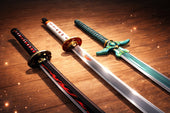
Kokushibo's sword may be the most extreme example of Nichirin blade design in the series, but the broader Demon Slayer roster offers some of the most visually striking replica swords available anywhere in anime. Whether you're drawn to the historical grounding of Tanjiro's black blade, the drama of Rengoku's flame-red katana, or the quiet menace of Muichiro's white Nichirin, there is a replica worth displaying.
If you are putting together a full character look for a convention, The Sword Stall's Demon Slayer Cosplay collection has character-accurate props and accessories built with events in mind. For collectors after a wall piece or a display blade with genuine build quality, the Demon Slayer Swords range covers the full cast.
We're proudly UK-based with free express delivery on orders over £200.